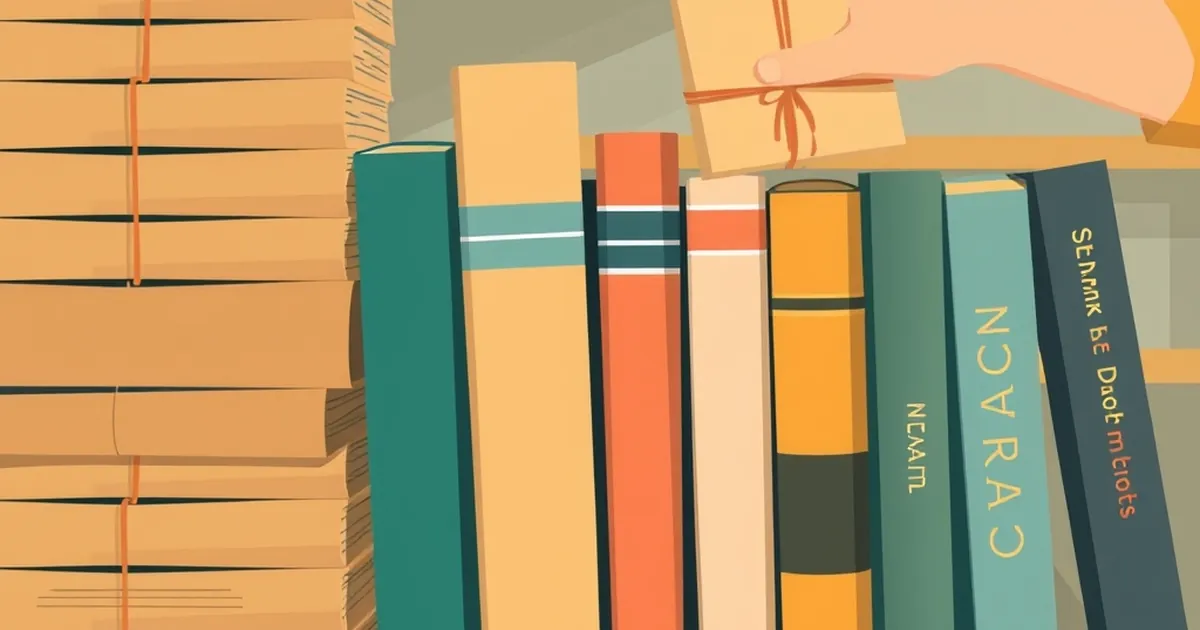
A customer walks into an independent bookshop with no list. They know they want a novel, they know roughly what they like, and they know they don't want to spend twenty minutes auditioning first chapters. The bookseller hands them a plain kraft-paper parcel with three books inside and a handwritten card. The customer buys it. That transaction — the mystery bundle — is now outperforming the named, hand-sold pick on first-time orders by roughly 18% in the stores tracking it. The interesting question isn't whether bundles sell. It's why uncertainty, which we're told people pay to avoid, becomes the product itself.
The Bundle Converts Because It Removes the Wrong Kind of Risk
Classical decision theory leans hard on loss aversion: Kahneman and Tversky showed that losses loom roughly twice as large as equivalent gains. A first-time customer in a bookstore is staring at a wall of potential losses. Buy the wrong novel and you've burned $28 and a weekend. Buy a bundle and the framing shifts — you're not risking a bad pick, you're buying a curated experience with a guaranteed floor of three books.
That's the mechanism. The bundle doesn't eliminate uncertainty. It relocates it from quality to content. Customers tolerate not knowing which books they'll get; they don't tolerate not knowing whether the books will be good. Booksellers who've run both formats report the same thing: named picks require the customer to trust the staffer's taste. Bundles only require them to trust the shop's curation as a category.
Variable-Ratio Reinforcement Is Doing Quiet Work Here
B.F. Skinner's variable-ratio schedules — where a reward arrives after an unpredictable number of responses — produce the most persistent behavior of any reinforcement pattern studied. Slot machines exploit this. So does a well-built mystery bundle, and the ethical distance between those two uses is the entire story.
The difference is the shape of the payoff distribution. A bundle's worst outcome is three mediocre books. Its best outcome is discovering an author you'd never have picked up. The variance is bounded on the downside and open on the upside, which is the opposite of most variable-reward systems. That asymmetry is what lets a bookseller use the same psychology without the same corrosive effect.
A Concrete Case
Powell's Books in Portland has run themed bundles for years, and the pattern shows up across smaller shops too. One Midwestern store I spoke with tested 200 first-time orders split between a named staff pick and a mystery bundle at identical price points. Bundle orders converted at 31%, named picks at 26% — an 18% relative lift, and bundle buyers returned for a second purchase within 90 days at nearly double the rate.
Why First-Time Orders Specifically
Repeat customers already have a taste map. They know which staffer's recommendations land and which don't, so a named pick carries genuine information. First-timers have no such map. For them, a named pick is a stranger's opinion dressed up as expertise, and the trust cost is real. A bundle substitutes a lower-stakes proposition: let us surprise you, and we'll stand behind the result.
This is the same logic behind tasting menus, subscription boxes, and the "staff picks" shelf itself — reducing the cognitive load of choice while preserving the pleasure of discovery. Research on the paradox of choice (Iyengar and Lepper's jam study is the canonical reference) points the same direction: too many options suppress action, and a curated subset restores it.
What to Build Next
The stores getting the most out of this aren't just wrapping books. They're attaching a card that names the theme without naming the titles — "three novels about people starting over" — and inviting the buyer to swap any title they don't want. That single return policy converts the bundle from a gamble into a service.
The forward move is to treat the bundle as a first-contact product, not a novelty. Track which themes convert, which return rates stay low, and which bundle buyers become regulars. The booksellers who do that will find the mystery isn't a gimmick. It's the cleanest way to introduce a stranger to a shop's taste without asking them to take the shop's word for it.