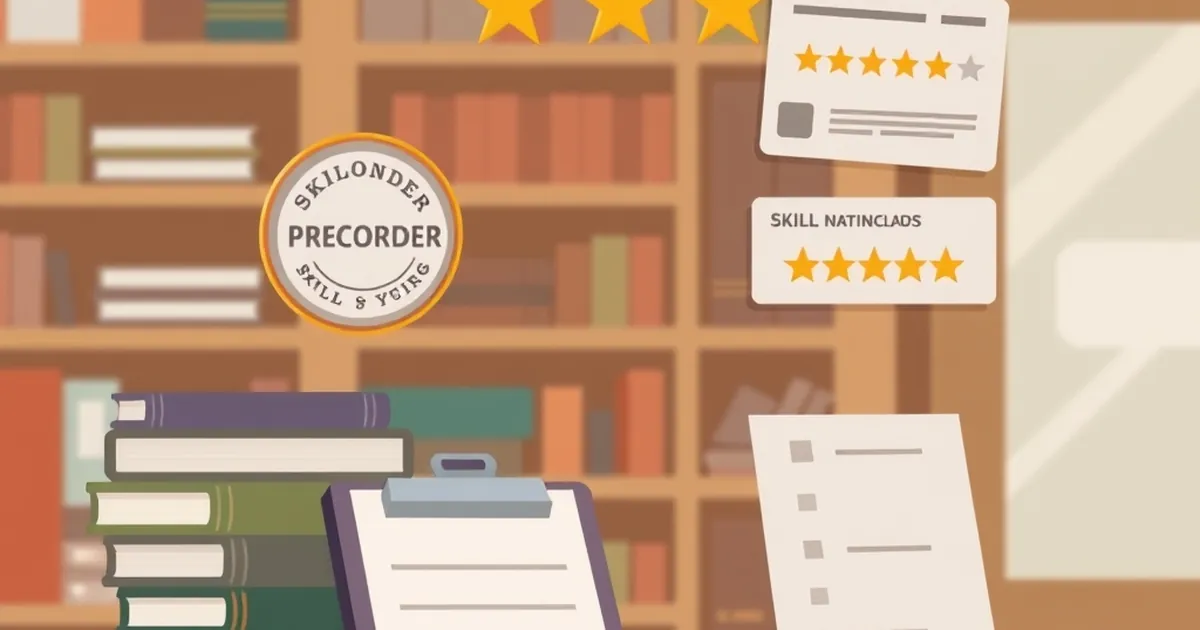
Why does a two-badge preorder page outsell a five-star listing? It's a question that surfaces every time a bookseller compares a lean, competence-signaling preorder campaign against a polished but generic one. The answer sits at the intersection of behavioral psychology and retail design — specifically, what signals reduce uncertainty when a reader commits to a book that doesn't exist yet.
The Uncertainty Problem in Preorders
Preordering is a pure act of decision-making under uncertainty. The reader pays now for a product they can't flip through, can't return easily, and can't verify against reviews that don't yet exist. Daniel Kahneman and Amos Tversky's work on loss aversion tells us the pain of a wasted $28 looms larger than the pleasure of a great read — roughly twice as large, in their framing. So the preorder page's job isn't to generate excitement. It's to reduce the perceived risk of being wrong.
Star ratings, paradoxically, do this poorly. A five-star average with eleven reviews reads as noise. It signals enthusiasm, not competence. And enthusiasm is cheap.
Why Skill Badges Carry More Weight
A skill badge — "Signed First Edition," "Indie Next Pick," "Staff-Reviewed," "Limited Print Run" — is a credential. It answers a different question than a rating does. A rating says other people liked this. A badge says someone with expertise vouched for this specific object.
This maps onto Robert Cialdini's authority principle, but with a twist specific to bookselling: the authority is embedded in the artifact. The badge isn't a claim about quality; it's a verifiable fact about the edition, the selection process, or the bookseller's labor. That makes it resistant to the cynicism readers bring to review sections.
Two badges also create what behavioral economists call a conjunction of independent signals. One badge could be marketing. Two unrelated badges — say, a curator's pick plus a signed limitation — are harder to fake and easier to trust.
A concrete case
Consider the preorder pages that consistently outperform on Bookshop.org and publisher direct stores: a small press title with a "National Book Award Longlist" badge and a "Reading Group Guide Included" badge will typically convert better than a comparable title showing 4.8 stars from 200 early readers. The star count describes a crowd. The badges describe the book.
Reward Loops and the Preorder Habit
There's a second mechanism at work: variable-ratio reinforcement. B.F. Skinner's schedules of reinforcement showed that unpredictable rewards produce more persistent behavior than predictable ones. Preorder culture has quietly built this into its rhythm — the surprise of a signed copy, a numbered edition, an author's handwritten note tucked in.
Skill badges amplify the loop because they promise a specific unpredictable reward rather than a vague one. "Limited to 500 copies" tells the reader the reward is real and finite. That's not a gimmick; it's information. And information is what a preorder page is actually selling.
Risk-Taking as a Reader's Identity
Readers who preorder are, behaviorally, risk-takers — but only within a narrow band. They'll gamble on an unknown author if the format is guaranteed. The badge structure lets them separate the two: they accept narrative uncertainty while eliminating transactional uncertainty. Booksellers who understand this stop trying to convince readers the book is good and start proving the purchase is safe.
What to Build Next
The forward move for booksellers and publishers is to treat preorder pages as credential displays, not popularity contests. Lead with two specific, verifiable badges. Put the star rating lower, where it belongs — as context, not proof. And design the reward loop around the artifact: the edition, the signature, the print run, the curator's note.
The readers who preorder are already comfortable with uncertainty. Give them two reasons to trust the object in their hands, and they'll do the rest.