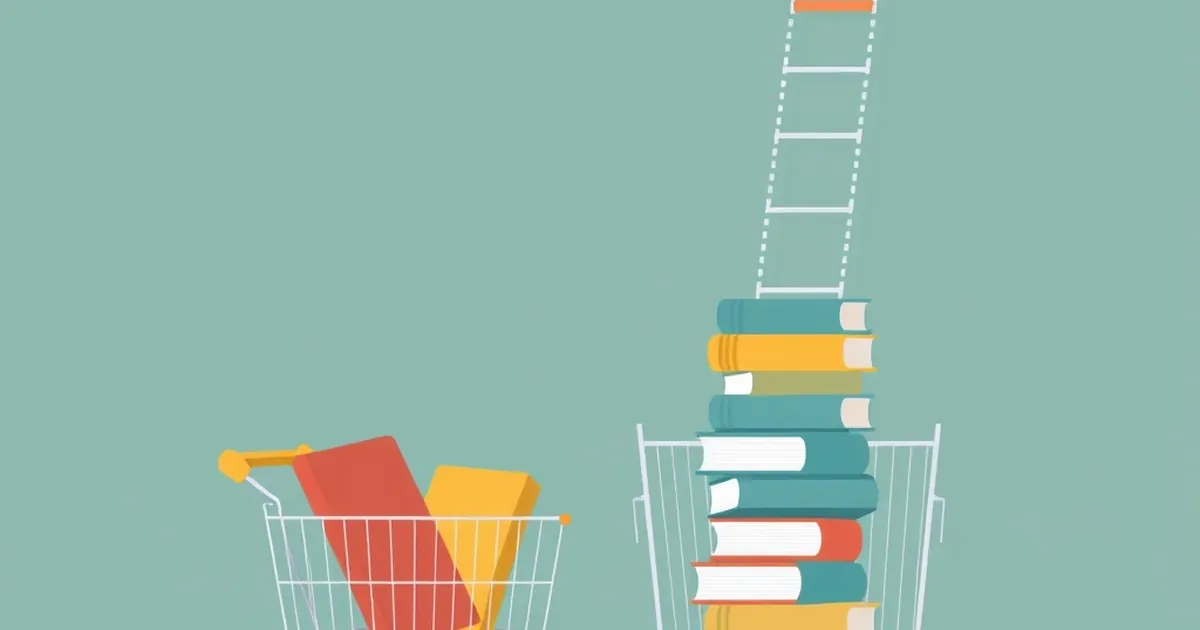
A customer adds two paperbacks to a cart, sees a $4.95 shipping charge, and adds a third book to clear the free-shipping threshold. Nothing about their reading list changed. The cart did. That gap — between what a shopper intended to buy and what the checkout page convinced them to buy — is where behavioral psychology, decision-making under uncertainty, and reward-loop design quietly shape the economics of independent bookstores.
The Threshold Isn't a Discount, It's a Reference Point
Free shipping at $35 sounds like a perk. Kahneman and Tversky's work on prospect theory suggests it functions more like a reference point against which every cart is judged. A $28 cart isn't "close to free shipping" in any absolute sense — it's $7 short, and the brain encodes that shortfall as a loss, not a neutral state.
This is the same mechanism behind loss aversion: losses loom roughly twice as large as equivalent gains. Paying $4.95 feels like a loss. Spending $7 more to avoid it feels like a gain, even though the net cash outlay is higher. The threshold reframes a purchase decision as a loss-avoidance decision, and loss avoidance is a far stronger motivator than the pleasure of saving.
Why Two-Book Carts Feel Worse Than They Should
A two-book cart is often a considered purchase — a reader who picked two titles, weighed them against a third, and settled. That deliberation matters. Research on the "IKEA effect" and on choice commitment shows that people assign more value to options they've actively chosen over ones they've passively accepted. The two books in the cart are chosen. The third book added at checkout is reactive.
That asymmetry is the whole trick. The store isn't selling a third book on its merits. It's selling relief from a fee. And because the shopper already feels ownership over the two books, abandoning the cart registers as throwing away something they'd decided to keep.
Variable Rewards and the Refresh Loop
Bookshops have an underrated advantage over most retail: browsing behavior is intrinsically variable-ratio. A customer scanning a shelf doesn't know which spine will produce the "I need this" moment. B.F. Skinner's variable-ratio reinforcement schedules — the same pattern that makes slot machines so compelling — describe this almost exactly, minus the harm. The reward is unpredictable and that unpredictability sustains the behavior.
Free-shipping tiers interact with this loop in a specific way. They add a second, more legible reward on top of the browsing reward: clear the threshold, get the perk. Two reward systems stack, and the second one is deterministic and easy to calculate. That's why thresholds work even on shoppers who know the game.
The Concrete Case: Bookshop.org's Threshold Behavior
Independent booksellers and platforms like Bookshop.org have reported that average order values cluster just above round-number thresholds rather than distributing evenly — a pattern retail analysts have documented across e-commerce for years. The clustering is the tell. If free shipping were purely a cost-saving convenience, carts would distribute smoothly. Instead, they pile up right past the line.
Bookstores face a real tension here. A three-book threshold can push a two-book reader to add a title they'll genuinely enjoy — or to add a paperback they'll never open, then feel mildly manipulated and buy less next time. The difference is usually whether the third book was discoverable at the moment of decision. If the cart page surfaces a $9 essay collection that fits the reader's taste, the threshold becomes curation. If it surfaces nothing, the threshold becomes a toll.
Where This Goes Next
The forward move for bookshops isn't to raise or lower the threshold. It's to make the gap fillable with something worth wanting. That means personalized recommendations at the cart stage, staff-pick bundles sized to the exact shortfall, and pre-orders that let a reader reserve an upcoming title against today's threshold.
The deeper shift is measurement. Stores that track only conversion rate will keep tuning thresholds and miss the more interesting signal: whether threshold-triggered additions get read, reviewed, or reordered. A third book bought to dodge a fee is a transaction. A third book bought because the cart page understood the reader is a relationship. The psychology is the same either way — only one of them compounds.