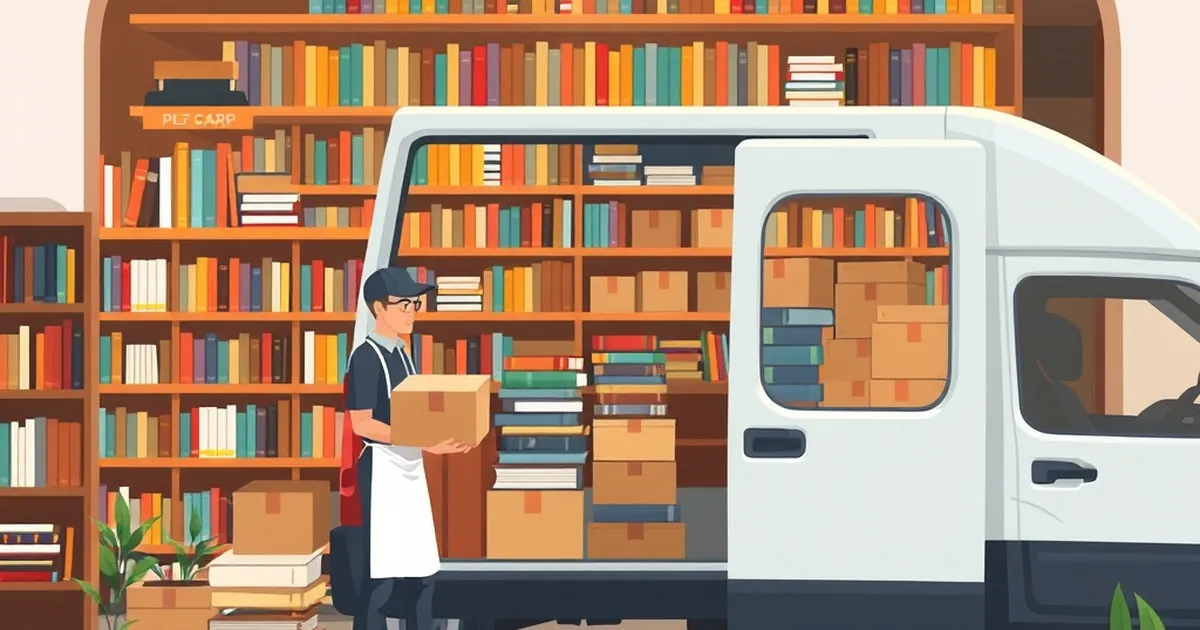
When you buy a book online, the promise of “free shipping” feels like a win. But for the independent bookstore that fulfills that order, that label is often a lie. The real question isn’t what the customer pays—it’s who absorbs the $4.50 to $7.00 it costs to send a single hardcover across state lines. For most indie shops, that cost doesn’t vanish; it gets quietly folded into their margins, their staff hours, and ultimately, their survival.
The Math That Doesn’t Add Up
Let’s break down the typical transaction. A customer orders a $28 hardcover from an indie shop’s website. The store pays roughly $3.50 for a media-mail box and padding, plus $3.00 to $4.00 for postage. That’s about $7.00 in shipping costs that the customer never sees. If the store offers “free shipping” outright, they eat that $7.00. On a book that carries a 45% margin (roughly $12.60 for the store), that leaves just $5.60 to cover rent, utilities, and the employee who packed the box.
Now compare that to a giant like Amazon. They negotiate bulk postal rates and run their own logistics network, so their per-unit shipping cost can be half of what an indie pays. When you see “free shipping” on a mega-retailer, it’s a loss leader funded by volume. When you see it on a small shop’s site, it’s often a desperate gesture of customer service—one that quietly erases the profit from the sale.
The Hidden Labor Behind the Label
Packing Isn’t Free
The cost isn’t just postage. Someone has to pick the title, wrap it, print a label, and haul it to the post office. On a good day, that’s ten minutes per order. Multiply that by twenty orders, and you’ve consumed half a workday. Most indies don’t have a dedicated shipping clerk; that’s the owner or the one part-timer who also answers the phone and restocks the poetry shelf.
The Return Shipment Gamble
Here’s a scenario that plays out weekly: a customer orders two books to get free shipping, then returns one. The store now pays the original outbound cost, the return postage, and the restocking labor. On a $15 paperback, that return can wipe out the profit from three other sales. It’s not malicious—but it’s a structural disadvantage that indies can’t price into the book itself without looking greedy.
When Free Becomes a Reflex
The bigger issue is consumer conditioning. For a decade, shoppers have been trained to expect fast, free delivery as the baseline. When an indie charges $5 for shipping, they’re not being unreasonable—they’re being honest. But the customer’s brain registers that $5 as a penalty, not a cost. I’ve watched shoppers abandon a cart over a $4.99 shipping fee, then turn around and buy the same book from a mega-retailer without blinking at the $35 total, because the line item said “FREE.”
One independent bookseller in Portland told me she tried raising her free-shipping threshold from $35 to $50. Her online orders dropped by 40% in a week. She reversed the change, but the lesson stuck: the word “free” has become a psychological anchor, regardless of what the total price is.
A Smarter Path Forward
The fix isn’t to eliminate shipping fees—it’s to reframe them. Several indies are now testing “bundle shipping” where customers pay a flat $3.99 but get a store credit of equal value toward their next purchase. Others are shifting focus to local delivery and curbside pickup, where the cost is near zero and the personal touch is high.
The practical takeaway for readers is this: when you buy from an indie, treat shipping like a tip. It’s not a fee; it’s the price of keeping a real human in the loop. And if you see a shop charging $5 to ship a $12 paperback, don’t bristle—that’s a business telling you the truth about what it costs to get that book into your hands. The future of indie bookselling won’t be won by pretending shipping is free. It will be won by convincing a critical mass of readers that paying for it is the better bargain.