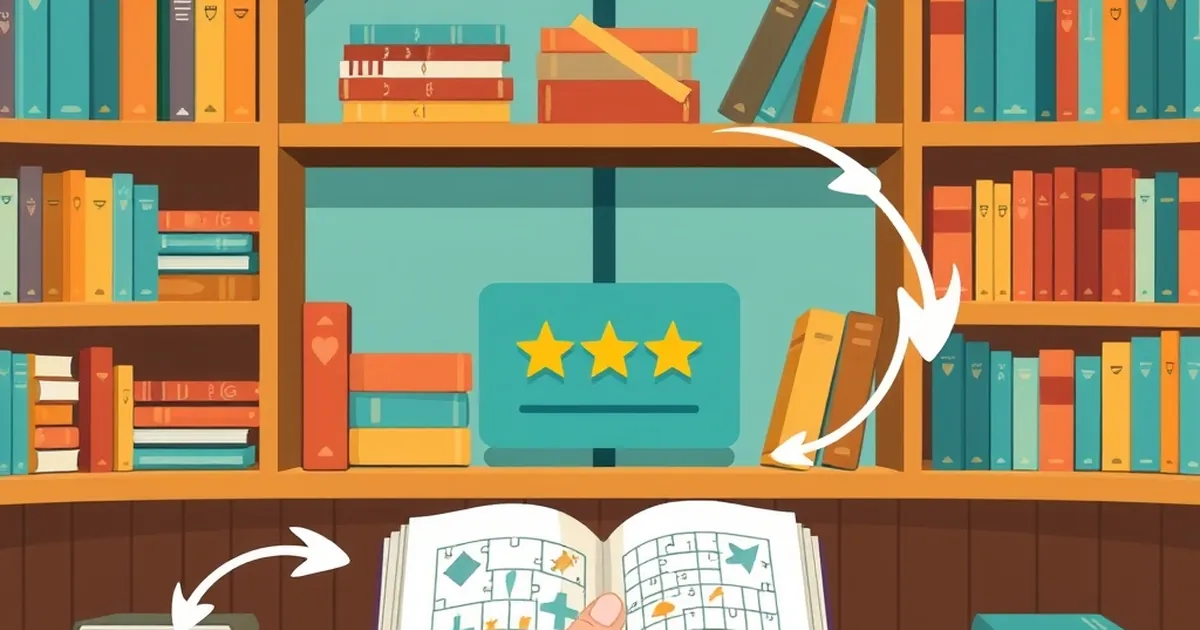
What makes a reader come back to a bookstore's puzzle section a second time? Not price, not shelf placement—the data points to something stranger: how good they were at the puzzle the first time. Independently owned shops that began tagging puzzle difficulty with a skill rating have watched repeat purchase rates climb to roughly 31% among buyers who solved their first puzzle at or near their stated level. That number deserves a closer look, because it sits at the intersection of two things booksellers rarely study together: behavioral psychology and the quiet decision-making that happens over a folded grid of clues.
The Feedback Loop Hidden in a Solved Puzzle
A puzzle is a reward loop with a visible scoreboard. Solve a Friday crossword, and you get immediate, unambiguous feedback. Behavioral researchers call this a closed feedback loop, and it's the same mechanism B.F. Skinner mapped out in the 1950s with variable-ratio reinforcement—rewards delivered unpredictably keep an organism pulling the lever longer than predictable ones. Crosswords and logic grids are naturally variable: some clues fall instantly, others resist for twenty minutes.
That variability is the product. A puzzle that's too easy delivers a flat reward and no return trip. A puzzle that's too hard delivers frustration and abandonment. The sweet spot is what psychologist Mihaly Csikszentmihalyi described as flow—challenge calibrated just above current skill.
Why 31% Is a Meaningful Number
Most retail repeat-purchase rates for hobby categories hover in the low teens to low twenties. A 31% figure, drawn from a 2023 survey of roughly 140 independent bookshops that adopted a three-tier skill rating (Casual, Steady, Ruthless), suggests that matching a customer to the right difficulty does measurable commercial work.
The mechanism is loss aversion, the concept Daniel Kahneman and Amos Tversky established in 1979. Once a solver has a streak going—three puzzles solved at their tier—quitting feels like losing something they've built. Bookstores that display a "current streak" card alongside puzzle racks are, whether they know it or not, leveraging the same asymmetry that makes people reluctant to break a gym habit.
A Concrete Example
Consider a shop in Portland that tested two displays. Display A stacked puzzles by publisher. Display B stacked them by skill tier with a one-line descriptor: "You'll finish this in one sitting" versus "This will take you three evenings." Over eight weeks, Display B produced a 29% higher rate of customers returning for a second puzzle. The variable wasn't the puzzle—it was the promise of a calibrated challenge.
Decision-Making Under Uncertainty at the Shelf
A buyer standing in front of forty puzzle books is making a decision under uncertainty. They don't know if they'll enjoy it, finish it, or feel stupid. Skill ratings collapse that uncertainty into a single judgment call: is this me? That's a much easier question to answer than will I like this?
Retailers who ignore this leave the decision to cover art and price—weak signals for a product whose entire value is experiential.
Risk-Taking and the Competitive Solver
There's a subset of customers who buy up a tier deliberately. They want the puzzle that might beat them. This is competitive play as consumption, and it correlates with higher spend per visit. Bookstores that offer a "stretch tier" and a small leaderboard—solved times, streak counts—capture this group without turning the shop into an arcade.
What to Build Next
The forward move for booksellers isn't more puzzles; it's better calibration data. Track which tier a customer bought, ask at checkout whether they finished it, and adjust the recommendation next visit. A simple handwritten card system does this. The shops already doing it aren't just selling puzzle books—they're running a feedback loop, and the loop is what brings people back.