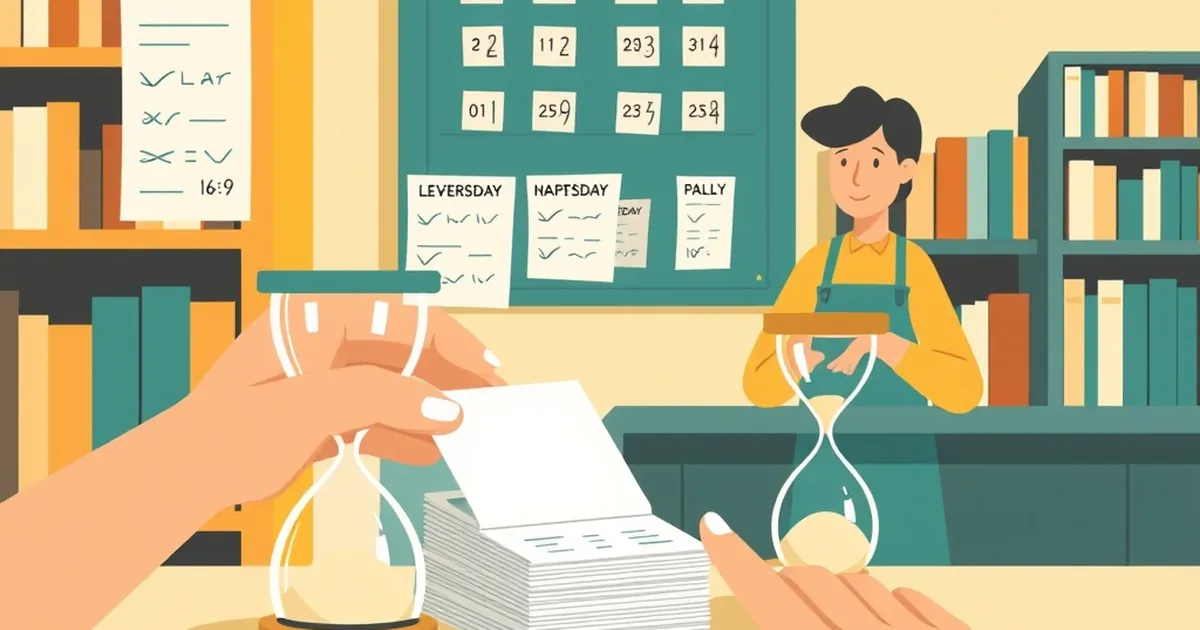
Loyalty programs are engineered to reward the behavior their designers want, not the behavior customers intend. Bookstore programs are a strange case: they reward a habit that is slow, deliberate, and often driven by curiosity rather than frequency. So why do so many readers watch points vanish before they've read enough to spend them?
The Math of a Slow Habit
A typical bookstore loyalty scheme grants one point per dollar and requires 100 points for a $5 reward. That sounds generous until you map it onto actual reading behavior. The median American reads about 12 books a year, according to Pew Research, and heavy readers buy in bursts: three or four titles at once, then nothing for weeks. If a program expires points after six months, a reader who spends $60 in January and $40 in July may lose the first batch before the second arrives.
Compare that to a coffee shop, where the same customer visits four times a week. The program's real design constraint isn't generosity — it's visit frequency. Book buyers simply don't generate the repetition that points systems are built to capture.
Why Expiration Dates Exist at All
From the retailer's side, points are a liability. Accountants call them deferred revenue; finance teams call them a balance-sheet problem. Expiration is the simplest way to cap that liability without cutting the headline reward rate.
Behavioral economics explains why this works on customers. Kahneman and Tversky's work on loss aversion shows that people feel a loss roughly twice as intensely as an equivalent gain. An expiring point balance is framed as a loss, which is precisely why it motivates a purchase — but only if the customer notices in time. When they don't, the same mechanism produces resentment instead of urgency.
There's a second lever at work: variable-ratio reinforcement. Rewards delivered on an unpredictable schedule produce more persistent behavior than fixed ones. Bookstore programs often layer this in through "double points weekends" and surprise bonus titles. The result is a system that trains buying frequency rather than reading frequency.
The Reader's Actual Decision Problem
Readers face genuine uncertainty when deciding whether to redeem. Will I finish this book? Will I want the sequel? Is the $5 reward worth buying a title I'm lukewarm about just to avoid losing points?
This is where loyalty programs quietly distort taste. A reader with 90 points and two weeks left may buy a book they'd never have chosen, because the marginal $5 feels like found money while the expiring balance feels like a loss. The program has converted a preference decision into a deadline decision.
One concrete illustration: Barnes & Noble's membership model has shifted over the years between paid annual discounts and points-based rewards, and each iteration changes the calculus. A flat 10% discount rewards browsing and patience. A points system with an expiration date rewards speed. Same store, same books, different customer behavior — the mechanism shapes the outcome.
Designing for the Way People Actually Read
The forward-looking move for booksellers is to align reward timing with reading cadence rather than shopping cadence. Some options:
- No expiration, but tiered thresholds. Points accumulate indefinitely; larger rewards unlock at higher balances. This removes the artificial deadline while keeping a stretch goal.
- Completion-based rewards. Grant a bonus when a customer reviews or finishes a book, verified through a simple prompt. This ties the reward to the behavior the store actually wants to encourage.
- Seasonal redemption windows. Instead of expiring points, offer a two-week redemption period each quarter. Scarcity stays, but the clock is predictable.
The deeper point is that loyalty programs are behavioral instruments, and instruments calibrated for high-frequency transactions misfire on low-frequency ones. Book buyers are not coffee drinkers. A program that respects the pace of reading — slow, episodic, curiosity-driven — will earn more genuine loyalty than one that punishes readers for taking their time.