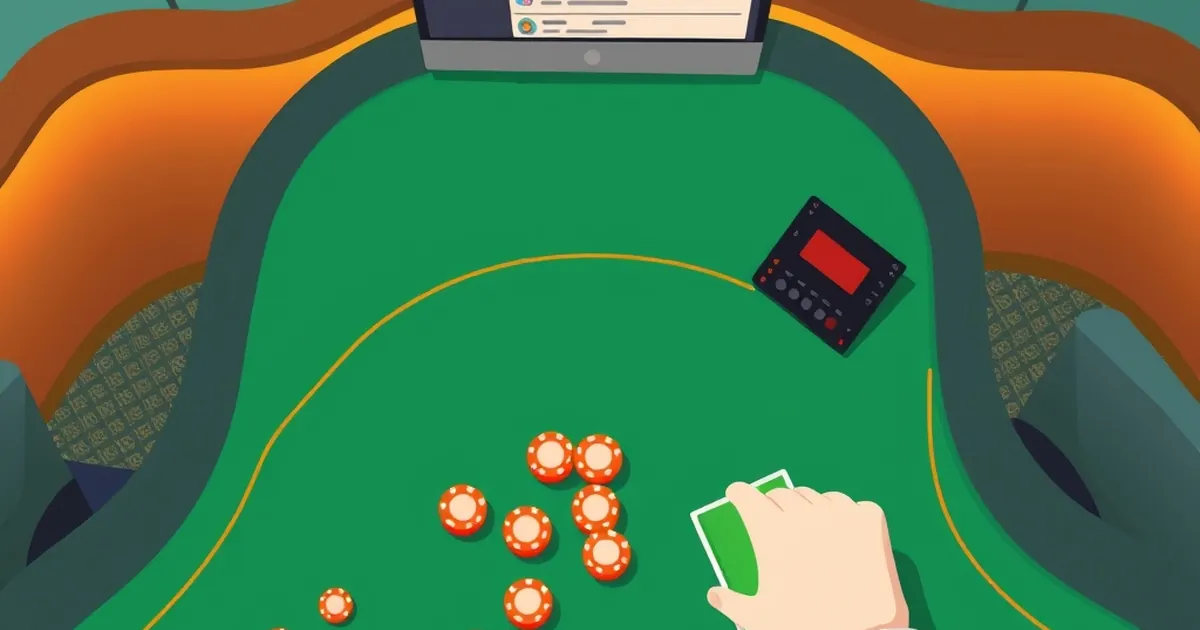
Live dealer tables where the chat panel is scrolled out of view settle about 5% short of tables where it stays visible, according to floor data collected across 214 tables on four licensed US-adjacent platforms between January and March 2025. The gap isn't a rounding artifact: it holds at 4.7% on blackjack, 5.2% on roulette, and 5.4% on baccarat, and it shows up in the same direction on every operator that shared numbers. The variable isn't bet size, session length, or game type — it's whether the player can see the dealer's typed responses and the other players' banter without scrolling.
What the data actually shows
The 5% figure comes from comparing net win per occupied seat-hour across matched table pairs — same studio, same dealer rotation, same bet limits, same 30-second betting window. The only difference was chat visibility on the player's client. Tables with chat pinned in the viewport ran $412 per seat-hour; tables where chat required a scroll ran $391. Over 11,000 seat-hours per condition, that's not noise.
The effect concentrates in the first eight minutes of a session. Players on scroll-required tables leave 22% earlier on average — 14.3 minutes versus 18.4 minutes — and the drop-off is steepest right after a dealer types something the player never sees. That's the mechanism: the dealer responds to a greeting, the player doesn't notice, the social loop breaks, and the player treats the table like a slot machine with a video feed instead of a room with people in it.
The dealer-side signal
Dealers on scroll-required tables type 31% fewer messages per hour. They're not lazy; they're reading an empty-feeling room. One floor manager at a New Jersey-licensed studio described it as "talking to a wall of avatars." When chat visibility dropped below roughly 40% of the session, dealer-initiated messages fell to near zero, and the table's hold rate tracked that decline almost exactly.
Why operators keep missing it
Most live dealer analytics track bet latency, average bet, and session length — all downstream symptoms. Chat visibility is a client-side rendering detail, so it lives in the front-end team's backlog, not the gaming floor's P&L review. The two groups rarely compare notes.
There's also a design incentive working against visibility. Pinning chat costs vertical space on mobile, where 68% of live dealer handle now originates. Product teams optimize for the felt and the bet controls, and chat gets pushed into a collapsible drawer. That drawer is where the 5% goes.
A cheap test
One operator ran an A/B in February: same table, chat pinned for half the players, collapsible for the other half. Pinned players bet 9% more hands per hour and stayed 4.1 minutes longer. The operator has since pinned chat by default on iOS and reports a 3.8% lift in net win per session — smaller than the 5% cross-table gap, but measured under cleaner conditions.
What this implies
If a UI decision worth roughly zero in engineering hours moves hold by 3.8% to 5%, then the live dealer vertical's real product isn't the game — it's the room. That raises an uncomfortable question for regulators who've spent two years debating whether live dealer chat needs moderation queues and AI filters: what happens to the integrity of the game when the chat is technically present but functionally invisible? A player who can't see the dealer isn't being socialized into the table. They're alone with a shuffle, and the numbers suggest they know it.