Free Shipping Thresholds Push Browsers to Add a Second Book
How loss aversion and free shipping thresholds nudge online book browsers to add a second title rather than abandon their cart at checkout
· 3 min
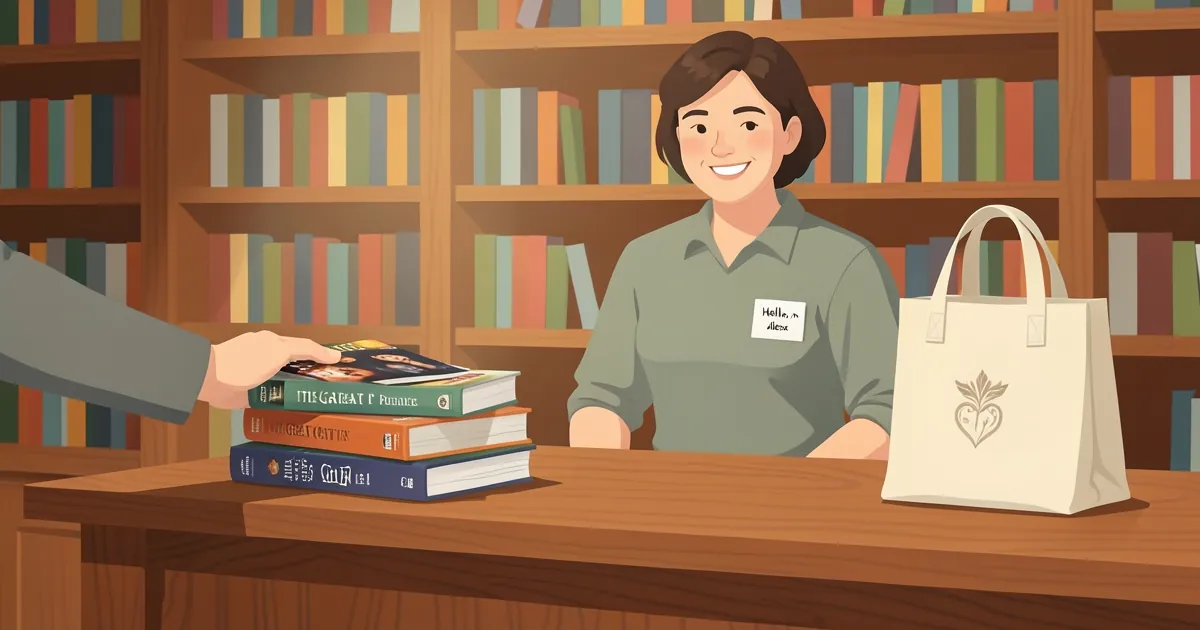
A reader adds one paperback, sees a subtotal of $18.40, and notices the store's free shipping bar sits at $25. Does she check out, or does she go back to the shelf? The answer depends less on her budget than on how the gap is framed — and that framing is where behavioral psychology and bookselling quietly overlap.
The Gap Reads as a Loss, Not a Discount
Kahneman and Tversky's work on loss aversion established that losses loom larger than equivalent gains. A $6.60 shipping charge is not experienced as a neutral fee; it is experienced as money leaving for nothing. Adding a second book converts that loss into a gain — a book in hand, shipping waived — which is why the second-book add-on feels rational even when the reader didn't want a second book ten seconds earlier.
Bookshops amplify this because their inventory is unusually easy to top up. A $25 threshold against a median order that lands just under it creates a permanent near-miss, and why median book orders rarely clear the free shipping bar is largely a story about price points, not reader intent. The threshold sits a few dollars above the natural basket, so the gap is always small enough to close and always present.
Variable Reinforcement and the Second-Book Habit
Behavioral psychology's most durable finding about persistence is the variable-ratio schedule: rewards delivered after an unpredictable number of responses produce the steadiest, most extinction-resistant behavior. Free shipping thresholds borrow this structure without meaning to. Sometimes the second book clears the bar with room to spare; sometimes a hardcover pushes the cart past a higher tier; sometimes a sale copy leaves the reader still short. The unpredictability is what keeps the browse going — and it is also what retrains readers toward cart abandonment when the arithmetic stops working in their favor.
There is a real cost to that loop. When the near-miss is engineered rather than incidental, add-on rates climb while repeat purchases fall; the pattern of near-miss bundles that spike the first order and suppress the second is worth studying closely before adopting.
Why the Second Book Is Usually the Wrong Second Book
The add-on a reader grabs under threshold pressure tends to be the cheapest thing that closes the gap — a slim paperback, a remainder, a gift edition — rather than the book they actually wanted. That has two consequences. First, the marginal sale carries thin margin after shipping is absorbed, which is what free shipping thresholds hide about a store's real economics. Second, the reader learns to shop the threshold rather than the catalog, and a store that trains threshold-shopping ends up with a customer base that only converts when the math is favorable.
A concrete illustration: a shop sets free shipping at $30. Its best-selling category is trade paperbacks at $17–$19. The natural two-book cart lands at $34–$38 — comfortably over — but the single-book cart at $18 is a $12 gap, too wide to close with one cheap add-on and too narrow to ignore. The store's median order barely moves, while its single-book carts convert poorly. Lowering the threshold to $24 doesn't fix the median; it just moves the gap. Tiering by weight or by format does something different: it makes the second book a genuine choice rather than a toll.
Design the Choice, Not the Trap
The forward-looking move for bookshops is to stop treating the threshold as a single number and start treating it as a decision architecture. Three practical directions:
- Make the gap visible early. Show the remaining amount on the product page, not at checkout, so the reader can plan a second book they want rather than panic-add one they don't.
- Offer a meaningful middle option. A curated two-book pairing at a slight discount beats a bare threshold because it gives the reader a reason to add a second title that fits the first.
- Watch repeat rate, not just average order value. A threshold that lifts basket size while depressing return visits is borrowing from next quarter.
The question worth asking of any free shipping rule is not "does it raise the average order?" but "does the second book a reader adds make them want to come back for a third?" Design for that, and the threshold becomes a recommendation rather than a toll booth.