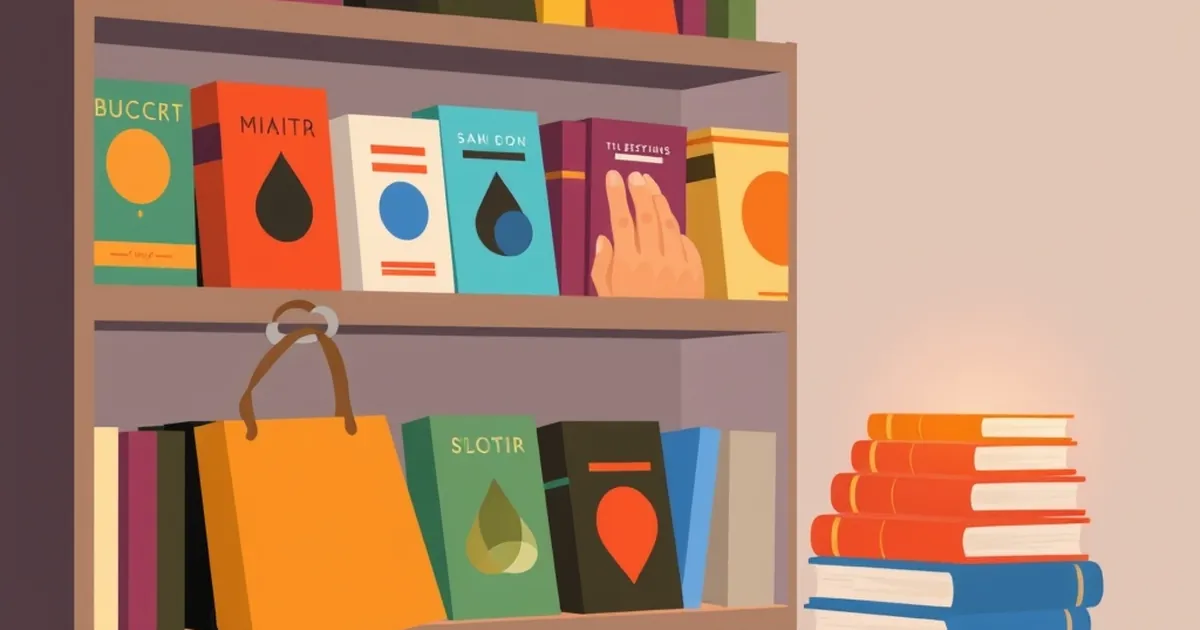
A bookseller in Portland once told me she keeps a single copy of Moby-Dick face-out because two copies create a decision, and three create a delay. Her observation maps onto a well-documented pattern: when choice multiplies, commitment often collapses. The question worth asking is not whether twelve covers overwhelm a browser, but why the overloaded shopper so reliably retreats to the bestseller table—and what that retreat costs both reader and shop.
The Paradox of the Crowded Table
Barry Schwartz's The Paradox of Choice popularized what psychologists had studied for decades: beyond a modest threshold, additional options reduce satisfaction and increase deferral. Sheena Iyengar and Mark Lepper's famous jam study found that a display of 24 varieties attracted more browsing than one of six, yet the smaller display converted roughly ten times better. Bookshops reproduce this experiment weekly without meaning to. A table of twelve new hardcovers, each jacket competing for the same three seconds of attention, functions like the 24-jam table—impressive to walk past, exhausting to shop from.
The retreat to bestsellers is not philistinism. It is a cognitive shortcut: the bestseller list has already done the comparing, so the shopper inherits a decision instead of building one.
Loss Aversion in the Aisle
Daniel Kahneman and Amos Tversky's work on loss aversion explains the asymmetry. A reader choosing among twelve unknowns risks something concrete—eighteen dollars and, more painfully, the hours spent on a book that disappoints. A bestseller carries social proof that insures against that loss. The expected regret of picking wrong from twelve outweighs the expected pleasure of discovering something wonderful, so the shopper pays a premium for certainty.
Booksellers see the arithmetic in real time. Hand a customer three curated recommendations with a sentence of rationale each, and conversion climbs; hand them the whole new-release wall and watch them drift toward the register with a safe pick or toward the door with none.
Reward Loops and the Pleasure of Browsing
There is a countervailing force worth respecting. Browsing itself is rewarding—variable, exploratory, mildly addictive in the way variable-ratio reinforcement makes any search pleasurable. Natasha Dow Schüll's research on machine interaction describes how intermittent, unpredictable rewards sustain engagement far longer than predictable ones. A well-merchandised shop exploits this deliberately: the pleasure is in the hunt, not the kill.
The mistake is confusing engagement with conversion. Twelve covers generate browsing; they do not generate buying. The shop that wants both designs the hunt so it terminates—staff picks with handwritten notes, three-book pairings, a "if you liked this, try this" shelf that narrows rather than widens.
Designing for the Decisive Reader
The forward-looking move for booksellers is editorial courage: fewer faces out, stronger arguments per book, and a visible hierarchy that tells the shopper where to start. Publishers can help by treating jacket copy as a decision aid rather than a blurb contest. And readers can borrow a tactic from behavioral science—arrive with one constraint, whether a genre, a mood, or a single trusted reviewer, and let that constraint do the eliminating.
The bestseller table will always be the safe harbor. The shop worth returning to is the one that makes the riskier pick feel like the obvious one.